July 28th, 2025
Romantics in Two Positions
Canon construction is a fascinating thing. That blithering moron Harold Bloom suggested that there is every possibility that the reason the Western canon is chiefly homogeneous in an identitarian sense is because social minorities just didn't produce anything that was as good. However, this is a failure to recognise that canons are for the most part a teleology whereby what is now considered aesthetically successful is so because it was always so. Outliers, as Bloom implies, should be excluded by way of meritocracy.
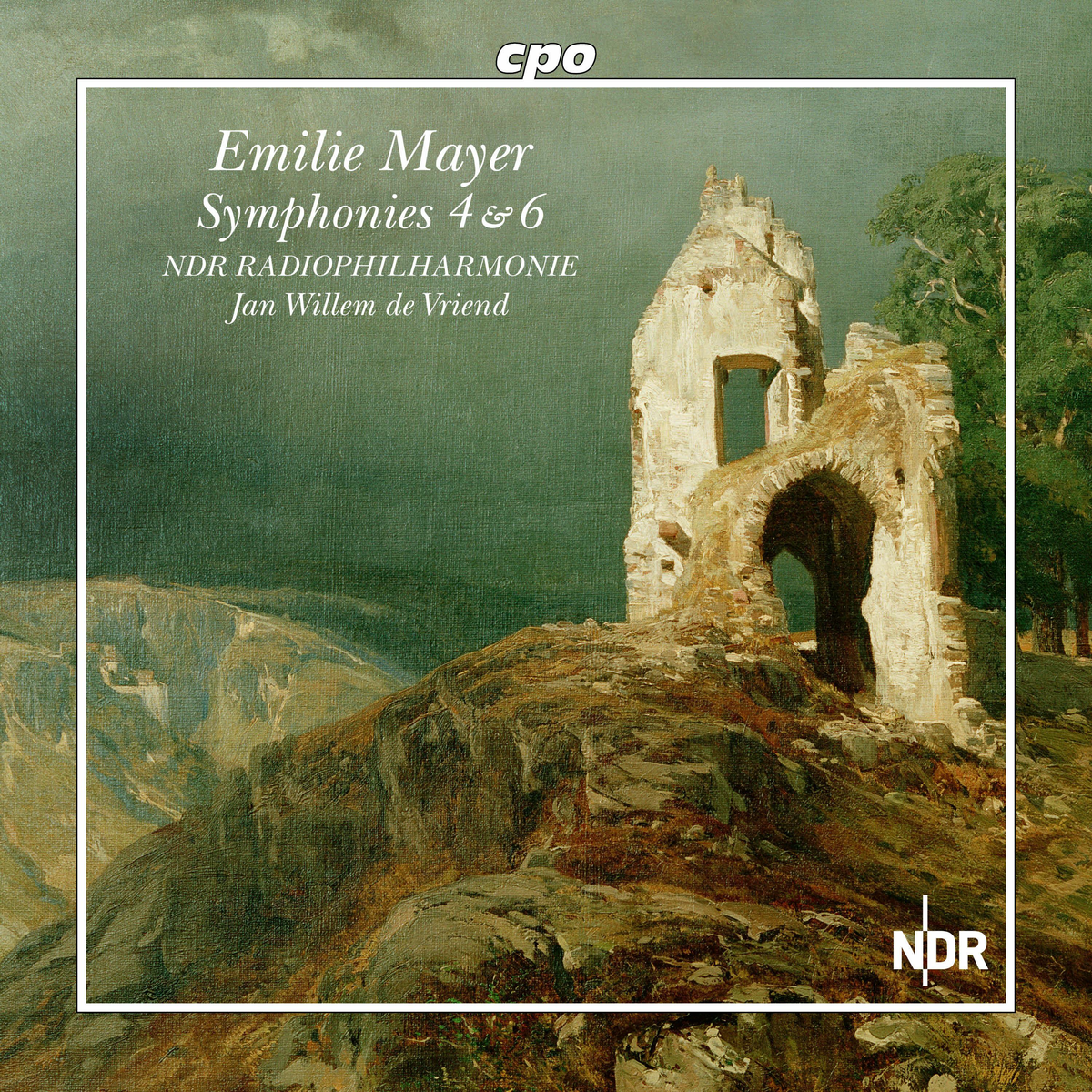
This is an assumed meritocracy, though. I say this because Emilie Mayer was very well liked in her lifetime and it is only posthumously that she has fallen outside of the teleological grip of the classical rolodex. To avoid revisionism, it is true that professional opportunities were limited for women in the Romantic era; the key difference, however, is that women were judged no less as capable aesthetes. The problem was reaching the accessibility of the judgement, but even then a cursory bit of research will reveal a huge well of names all contemporaneously respected and now obscure. In my own country, the project of revivifying the music of Ethel Smyth is well underway and it seems that CPO, ever-champions of the wider repertoire, have placed good stock in their own countrywoman. They are correct to do so. These two symphonies are a whirlwind of modulatory genius, double counterpoint tectonics and crystalline, heterogeneous orchestration. Evident in her chamber work is a penchant for call-and-response solo lines but the dialogue that these pieces stage between the woodwinds and strings is one of emotionally potent but sparklingly unpretentious German Romanticism.
All of this was obvious to her audiences, of course, and it led to her being labelled the Female Beethoven. We should not, ourselves of course, become attached to the notion that her career was not to some degree conditioned by masculinism: the expectation for her was to become a mother and housewife, but her father's suicide left her with an inheritance that allowed her the freedom to compose professionally after receiving private lessons in her childhood. What Bloom therefore misses in his canon interpretation is its class determinism. The freeing of a woman through personal tragedy is an unfortunate contradiction particularly common in the nineteenth-century if we are to believe the accuracy of novels like The Odd Women and A Laodicean and it is true in this music too. The whiplash of tempi in the fourth symphony creates an asymptotic blur of privately-educated classicism and Wordsworthian tonal colours without producing a complete synthesis. Mayer revels in her ability to suggest a multiplicity of forms in the same phrase, similar to a transitional figure like Spohr but with the humility to not succumb to a total aestheticism. The modulations in this music are at all times forward-thinking, yet the modern ignorance of its existence is akin to Boccherini's relative obscurity in the face of being labelled "The Wife of Haydn"—the canon mystifies that which is feminised.
None of this is Mayer's fault. Like I said in my review of Jutta Hipp, it is also partially up to the listener to not fetishistically produce an ontic femininity in the music as we cognise it. That this writing is in the process of concluding having dealt almost exclusively with the problematic of gender is indicative of the work that still needs to be done in this regard; with any luck reviews like this will be unnecessary in a few decades' time. However, at least Hipp got to keep her own name. It would be well to deconstruct the nonsense that is a label like "Female Beethoven" into its constitutive subject—Emilie Mayer. At that point she can be removed from that infinite rolodex and, like Beethoven himself for this ever-recursive canonical-fetishistic recording industry, be put on speed dial—these wonderful symphonies deserve nothing less.
So, yes, the saboteur in this instance is not an old-world chauvinism but the very modernity we are supposed to be civilising ourselves into in the first place. The fourth symphony here is actually a posthumous reconstruction: the original score is lost despite it winning her a medal from the queen of Prussia. For all of its sexist antagonisms, it was not the superstructures of the nineteenth-century that misplaced this work, it was ours. Should we begin to undo this ideology, starting with the rejection of Bloomian canonisation, we might be able to get to the point where we can approach this music if not phenomenologically then at least away from the spectres of Beethoven and Brahms and Schumann and Mendelssohn... the teleology wobbles when we make considerations like this, and CPO has gloriously made them much easier. Eat your heart out, Aristotle.
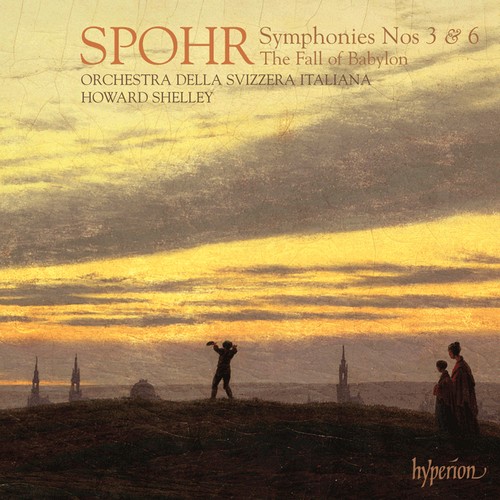
We all of us know the historic tenets of Louis Spohr by now: fashionable in his lifetime, inventing a couple things that are still in use in classical music today, before gradually slipping down the hierarchy of the canon and ending up as—if not the butt of classical jokes—a signpost of conservative, even reactionary, mediocrity. However, I maintain that he was a very capable composer when he wanted to be, and this usually occurred whenever he experimented with classical form. And this, his modern reputation be damned, did occur: he composed for two overlapping symphony orchestras, call-and-responding string quartets and a quartet concerto. His body of symphonies, too, is heavily programmatic and thematic; of course it doesn't take a genius to spin an allegory and put a subtitle on a score, but for a man mostly regarded as rigid and uncurious it's all a bit of an oddity. These unique arrangements combined with him writing a surprisingly modernistic treatise on aesthetics by nineteenth-century standards and, without exaggeration, attempting to formulate a meta-referential symphony that narrativises the divine Genesis of music, at least speak to some kind of ambition.
The problem with Spohr a lot of the time, though, is just how much labour the word "attempt" has to perform in sentences about his music. For all of its ambition, "Die Weihe der Töne" is never very exciting and, if that does indeed see him at his theoretical peak, his sixth symphony is his most theoretically bankrupt. It is also meta-historical, but the aim here is largely satirical—or, if not wholly, it at least has a satirical punchline. Yes, as the incredibly catchy "Historische Symphonie im Stil und Geschmack vier verschiedener Zeitabschnitte" would indicate, this is a symphony not tracing the creation of music as a Platonic category but the creation of individual musics: Bach-Händel, Haydn-Mozart, Beethoven and the rather non-reverentially titled "Newest Period". This is what structures the movements of the piece, a kind of two-dimensional temporality where the listener is supposed to be moved through the Baroque, Classical, Romantic and "Newest" periods at the same time as they are moved through the piece itself. This is not an easy thing to pull off, and Adorno's (in)famous chastisement of Stravinsky rings in the ears here, perhaps even Saint-Saëns' disdain for Les Six. However, their respective criticisms, of trying to present a classical temporality that does not actually exist and of the modernistic corruption of a quasi-sacred tradition, do not apply here. Spohr in this symphony is doing what I suppose is the complete negation of neoclassicism, if we take neoclassicism to be the insertion of modernistic harmonic content into classical form, by inserting a romanticist, deific reading of classicism into its own form. If "Die Weihe der Töne" is interpretable as locating in music a theological root, it is only insofar as Spohr believes the music of his conjuncture to be that which God* willed.
The result of this is that the first three movements of the symphony are treated with a tremendous gravitas that goes beyond accurately interpreting their historical context and simply reifies them into objects of divine reverence. Put simply, they are a barren wasteland of sentimental kitsch. Putting aside the fact that Haydn and Mozart were well known for their senses of humour, barely composing twenty pieces this self-serious between them, the Beethoven portion is incredibly humourous but not in a way I imagine Spohr intended. Now, Spohr, despite presenting Beethoven not as an individual but as an event of divine intervention on the landscape of contemporary music, apparently considered him an unprofessional, careless musician. What I suspect is happening in this movement then is Spohr's approximation of Beethoven's style stripped of his apparently distasteful presence near the instruments themselves. This symphony was composed in 1839, however, so Spohr's bias is readily apparent considering the Große Fuge had debuted thirteen years previously and eradicated any notion of Beethoven even being reducible to one "style". Much like any lightness is stripped from the Haydn-Mozart period, leaving behind a romantically-augmented heap of pastiche, what we get here is a version of Beethoven that is staunchly homogenous: a romanticist reading of Romanticism itself. It is meta-referentiality without self-awareness (if it were, it wouldn't be romantic), and in its refusal to be anything else except what it thinks it is trying to be, it is alienated from the flow that history is supposed to be constituted by. In the end it reveres nothing but its own concept of itself.
However, Adorno still doesn't apply here, for what all of these historical movements are in service of is the very last one. The "Newest Period" movement is possibly the most fascinating thing Spohr has ever composed, essentially as musical self-sabotage. In this movement we are not tracing history but Spohr's present, and much like his historical bias is obvious in the earlier movements, the last is basically just his opinion of his conjuncture's most contemporary music in musical form. Now this is meta-reference! The whole thing is an absolute mess: overly bombastic, melodies that trail off into absolutely nothing, harmonies that imply resolution before carrying on, percussion with a genuine sense of comedic timing. All, of course, intentional by a Spohr presumably smirking to himself when, upon its 1840 debut, the audience's reaction was one of bafflement. This meant, he wrote, his representation of the new music was correct—but his skewing of what is most likely Adam and Berlioz sound nothing like Adam and Berlioz just like his Mozart sounds nothing like Mozart. It all remains fundamentally Spohr, with Schumann even remarking that one could not escape his name after the premiere—the audience were not decrying Berlioz as they sat in their seats; they were baffled not because they had been finally awakened as to what nonsense the new music actually is, but because they had just witnessed a meltdown in notation.
The delightful thing is, then, that this is a composition fundamentally inseparable from Spohr even if the ambition aims beyond himself as subject. It reveals much more about him than it does any of the periods it tries to represent. On this disc, it is preceded by the third symphony and its naked lack of ambition makes for a massively fascinating contrast. Shelley's conducting is good, bringing out all of the exaggeration where it is needed—I think playing this plainly would defeat the point of the exercise. It needs its satiric bombast and its deific-reific treatment of its material in order to survive. For, I think, if these things were absent it would turn the piece into Spohr's worst nightmare: just another symphony. Of course, in all of its romanticist sludge it basically just is another symphony, but what Spohr was looking for was, by his own admittance, reaction. Without his name rattling around in Schumann's head, Spohr might have ceased to have been remembered at all. At least, with this beautiful mess of a symphony, he can be. Just perhaps not very fondly.
*Spohr was a freemason, but freemasons insofar as they have to believe in some kind of supreme being may as well believe in something analogous as God and it makes for much better sentence.
Works consulted:
Theodor Adorno, "Stravinsky: A Dialectical Portrait", in Quasi una Fantasia