latest article - Nov. 5th, 2025
Venteuil's Open Casket
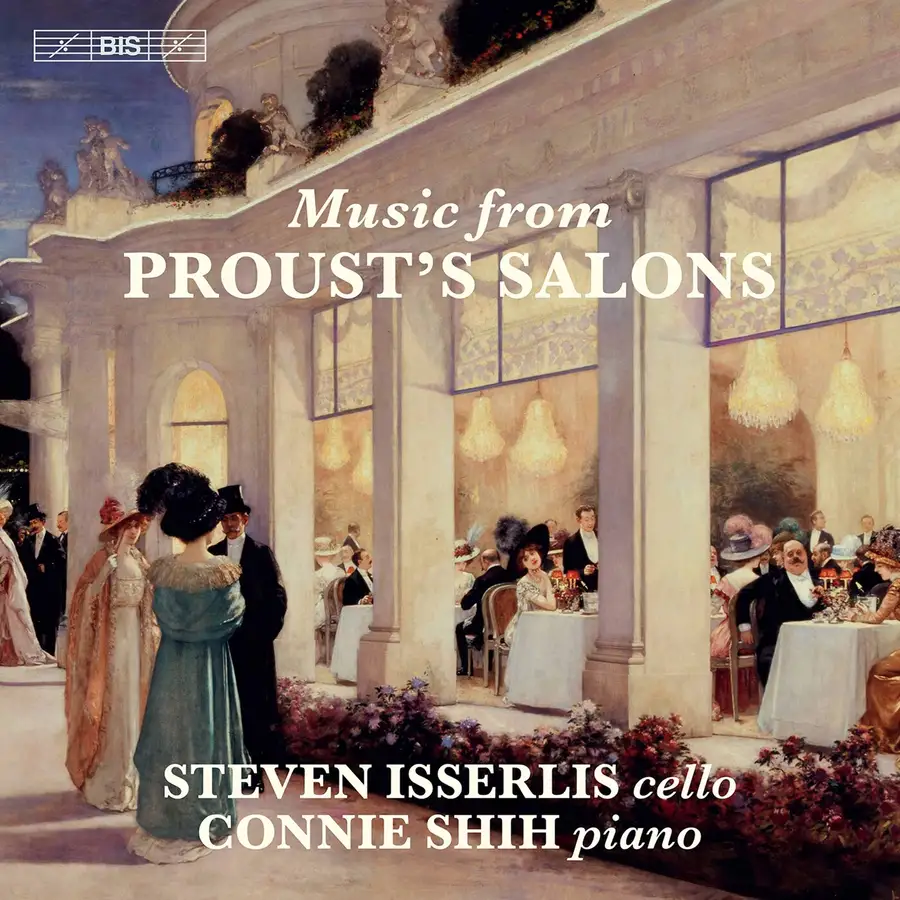
We read music and we read text. That they are one and the same thing is a bit of a Derridian suggestion, but I offer it nonetheless in this very literal case of a blurring of the two. It is a blurring, though, that has a strange kind of internal hierarchy in the sense that we are told this is salon music. It does not necessarily mean this is background music (the liner notes to this album try to plead its being anything but) but it does mean a specific space has been constructed for its occupancy. "Proust's salons", we can assume, are either the salons from In Search of Lost Time or the salons Proust actually held. The popular reading of Proust's novel would be to assume these two things essentially one and the same. Yet, within his novel the salon artists often assume mechanical roles and afforded not much beyond a pronoun and diminutive: "the painter", "the young pianist". The named Venteuil is somewhat of a tragic figure, devoted to his compositions and his daughter who both seem to posthumously despise him, save for a single sonata that becomes popular if not with all of France then at least with Swann and Odette and therefore the reader.
There is a tugging at the music at a material (Proust's salons) and textual level (the novel's) in this scheme. Do the pieces recorded here occupy a pre-constructed space or are they constructing the space of the salon in their performance? If the latter is not a primarily musical space but one of sociocultural reproduction, what does that do to our perception of the music? In the novel, what of Venteuil's sonata survives in the musical sense? What remains of it at all when it has to be transliterated into a different kind of sense in order to be interpreted by the characters and by proxy the reader?
Neither sense remains wholly itself if we read music as we read text. There is a kind of reversal here, then, in that we get the pieces without the effects we are told they had on Swann and Odette or by proxy Proust himself if his novel truly is autobiographical. Venteuil is a fictional composer, of course, so what we are reckoning with in the text if we are displacing it onto Proust himself is a sense of his musical life. Venteuil, a person trampled on, lives through the affective legacy of his art but not through any first-personalism. After he dies it is his music that assumes his "I" for him but this is quickly corrupted by Swann and Odette's transliteration both as ink on the page and as their subjective memory trigger. For all the popularity of the Madeleine cake scene we do not know of what significance the cake had to its baker. Memory triggers are as effects in the novel insofar as they are produced by a cause: those that are not part of nature have to be produced by other humans, usually as commodity. The narrator, if we take him as microcosm for some facet of human experience, is a device through which involuntary memory is explored but this involuntariness is more often than not handed to the subject either by its immediate producer (the baker) or its interlocutor (the aunt). Imagining everyone in the world to possess a similar capability of interior narrative is to imagine cycles of phenomenal reproduction triggering noumenal cycles of reproduction triggering the impulse to narrativise the latter, to produce it as text. The world is run on these real-imaginary-real transpositions, and the novel is a form intimate with capitalism regardless of what appears to be the purely subjective style of Proust. If you like, you can purchase the clothbound gift edition of the novel, the full cycle of which will cost you £66 and in C.K. Scott Moncrieff's inferior prose, which transliterates the language into flowery Oxbridge vernacular in order to suit the novel market of the period.
So it seems we are provided with an object here too. The particular grammatical structure of the album title, Music From Proust's Salons, betrays an extractive process that has taken place before we have been handed the music. An event has pre-supposed the music, although it would look stranger still if it were named Music For Proust's Salons for the simple fact that Proust's salons are no longer taking place, even if it would mean the music has taken an eminent position in the syntactical hierarchy. However, if we take Pierre Macherey's advice that the novel is never truly closed, Proust's salons can be ongoing again as soon as one opens their copy of the novel. Now we have Proust's salons as they existed literally, his salons as they existed autofictionally and his "salons" as he narrativises and satirises them most often in The Guermantes Way. The grammatic mesh that dialecticises this trio may be written as ["["]Proust["]'s ["]salons["]"] insofar as we will always remain unaware of just what level of representation we are at thanks to the album title handed to us to contemplate as object from whomever at BIS decided upon it. No doubt the construction of the historical object of Proust's literal salons is the intention of the collection, with the music being its voluntary trigger, but insofar as the liner notes literally uses the phrase "may have" we can assume we are in the syntactic territory of ""Proust"'s salons": an educated guess at the affectivity of the man himself and of the evenings he hosted.
Is this a particularly comfortable position for music to exist in? Even further, is it a comfortable space for music to be expected to produce? That little betrayal "From" suggests the space has been pre-constructed but the listener is unaware of such a locus until they listen and begin to imagine based on the same historical assumption that produces the liner notes. At that point every listener finds a different locus for every piece and all of sudden ""Proust"'s salons" seem more ambiguous not because we are filling in the gaps of his character but beginning to imagine the salons that we are told were an actual, documented event. The grammar is now starting to resemble ""Proust"'s "salons"" purely because the salon is wholly imagined also. In this sense the music actually displays a striking fidelity to the novel, because there is no salon in the novel but only "salons"—fictive satires constructed from Proust's imagination and related to the reader through the use of affect in the same way that Vinteuil's sonata is transliterated. No matter how historically accurate the liner notes to this album are, the fact that they are liner notes to an album and not a text in-themselves—no-one would publish a 30-page pamphlet about a musical recording that does not exist—gives them a position secondary to the music. This means that no matter their textual description it is the affects of the music that constructs the loci of the salons in the imagination of the listener. This will of course be different for every listener. This could be different for the same listener during multiple listening sessions. This is the trouble with attempting to construct a historical object out of loose threads: you end up with a subjective phantasie.
Is that, however, not precisely the idea of the novel? That one is always out of reach of an object they are sure has been carefully constructed? Memory and imagination are unreliable narrators both and the novel's narrator reckons with his own status as storyteller on numerous occasions. Its very style, that flash flood of commas that makes it so famous, would suggest that the narrator is not consciously curating a novelistic mode of writing but rapidly switching between numerous triggers, affects, loci, as if all the loci were univocal. Anna Kornbluh suggests that novels "mediate" the capitalist relations which produce them, and so it would follow to say that Proust's rapidly arising and fading sceneries is a becoming-memory of narrative that mediates the contradictory economics that pushes it through the printing press and onto shelves. Capitalism is in the last instance reliant on staticity: the very grammar of Marx's economics uses the phrase "constant capital" in a way we must take very literally here. The prioritisation of movement within Proust—for we do often say "within Proust" as he only produced one truly famous work and we speak of it as if it were his existence—racks against the edges of the pages until it produces them into a number of thousands. It is a huge, insolent text in the same way that impressionism was thought so. The length of the realist novel qua Trollope and Thackeray derives from the recalling of detail in linearity. The length of the stream of consciousness novel derives from the flashing of various loci of memory and their different senses which often take a long, winding path not to just describe but to become. To become-sense is to fully submit to each affect as it appears without the impulse to take historical note of their origin: to not arborify one's reaction to art but to make one's body the rhizomatic site of the affect.
This does not mean the historical impulse is worthless. To me, in fact, almost the opposite is true, but one can feel stultified when encountering an album tied up in such complicated grammar as this one and trying to locate an exact point of origin for it. The locating eventually becomes, as it has here, its own kind of narrative that isn't actually reducible to the album in the last instance. The final grammatical mesh of this piece is "Music From ["["]Proust["]'s ["]salons["]"]", given that I have created out of this album a new narrative object that has transliterated it from music to text. This is because the music itself is a repetition: a historical one in the sense that it is attempting to tell us something that has definitely happened, an economic one in the sense that the relatively expensive SACD format has been decided as the one to be sat on shelves, and a philosophical one in the sense that the sense of the event—real or imagined—is what the music eventually becomes and what Proust ironically repeats in his novel. One may listen to this entire album front-to-back as its intended narrative, listen only to Saint-Saëns' miraculous cello sonata—at which point the listening becomes more about that piece than it does the narrative it is contained within—or write about it such that it becomes-text. In this sense, we repeat and we sense: we read music and we read text. That they are one and the same thing is a bit of a Derridian suggestion, but I offer it nonetheless in this very literal case of a blurring of the two...
Works consulted:
Jacques Derrida, Dissemination
Maurice Godelier, The Imagined, the Imaginary and the Symbolic
Pierre Macherey, A Theory of Literary Production
Anna Kornbluh, Immediacy or, The Style of Too-Late Capitalism
Gilles Deleuze, Logic of Sense; Francis Bacon; A Thousand Plateaus (with Felix Guattari)
For "affect", see Fredric Jameson, The Antinomies of Realism