November 1st, 2025
Pockmarks
Today I went to London. This statement exists as a superposition insofar as every person who reads it will place it in a space relative to their own, boring or exciting or both and neither, in order for it to be interpretable. Completely normal psycholinguistics. However for me it is a pretty charged statement as an agoraphobic person from (relatively) the country who was only born about one county over from imbibing "That London" into my vernacular. It also meant the first long-distance train journey I had been on in quite some time and as I was reading my phone began playing Alva Noto and Ryuchi Sakamoto's piece "Uoon II". This isn't their most popular, at nine minutes long and mostly a repetition of the exact same chord with a huge amount of reverb, microsounds and additional piano played over the top. However shuttling through Norfolk and then Suffolk and then Essex countryside with the sun gently rising over the copses disappearing before they even began to formulate placed both the green and the music into a unique space of their own.
Norfolk gives you a quite special relationship to the countryside, I think. Local biases aside—although I notice my complete rejection of patriotism and nationalism is sublated into my genuine love of "my" county—Norfolk is a wonderfully singular, planar environment. Everything is flattened, including unfortunately the social attitudes in a lot of places, but the constant monophonic textures that run off into the horizon make you wonder if that old myth about the ancients believing you could sail off the edge of the world didn't actually take place on a John Deere. Upon the plane is placed basically everything except Ravens and Capercaillies, it is what Spinoza would probably call substance. I am not religious, and I am not American, but when they use the phrase "God's country" I almost want to invite them here to see what it really looks like. To me it would seem as if the similar phrase "God's plan" is missing a crucial vowel right at its very end. This is the nature of the completed phrase, though, in the same way that the completed phrase is the unfortunate fate of nature in many cases. At least a century has passed since we knew about the devastating effects of the rationalising of nature and now Norfolk is the place in Europe with the most factory farms per square mile. The plane is still flat but the copses acquire an unnerving consonant.
In its own way the full stop that ends "Today I went to London." incurs its own destruction as the eraser of context but also the becoming of questions: why? How did I get there? What did I do? If I just began writing about a section of Chelmsford one would be wondering about how on earth I ended up on a train if not to Chelmsford then somewhere. The nature of trains is a striation through smooth space that also implies a striation in language when we talk about them. No one gets on a train to Somewhere unless they fall asleep, as I did on a train to Cromer when I was a child. Suddenly, whatever "Sheringham" was has ended up in my mind as that slab of concrete and yellow paint that was as sequenced with the dream I was probably having as if connected to the same assemblage. Sheringham is to me its train station sign and the declaration and laughter from my father's much more northern accent that, haway man, we're in bloody Sheringham. Somehow multiple people can end up somewhere even though they knew for certain they were going somewhere else. The dream on the Cromer train was a smooth space that transposed itself into the real to break the tyrannical striation of the carriage. If you are not from Norfolk you will have almost certainly never heard of Sheringham. For most of the people I will ever meet it will likely never exist; it is a secret dreamed up by the green of my home as a place for that memory of my father, which as my childhood fades away from me is starting to become rarer, to live. Of course it is betrayed now, but for all I know you might yourself need to take an impromptu nap on a train to Cromer to access it. I am content with that.
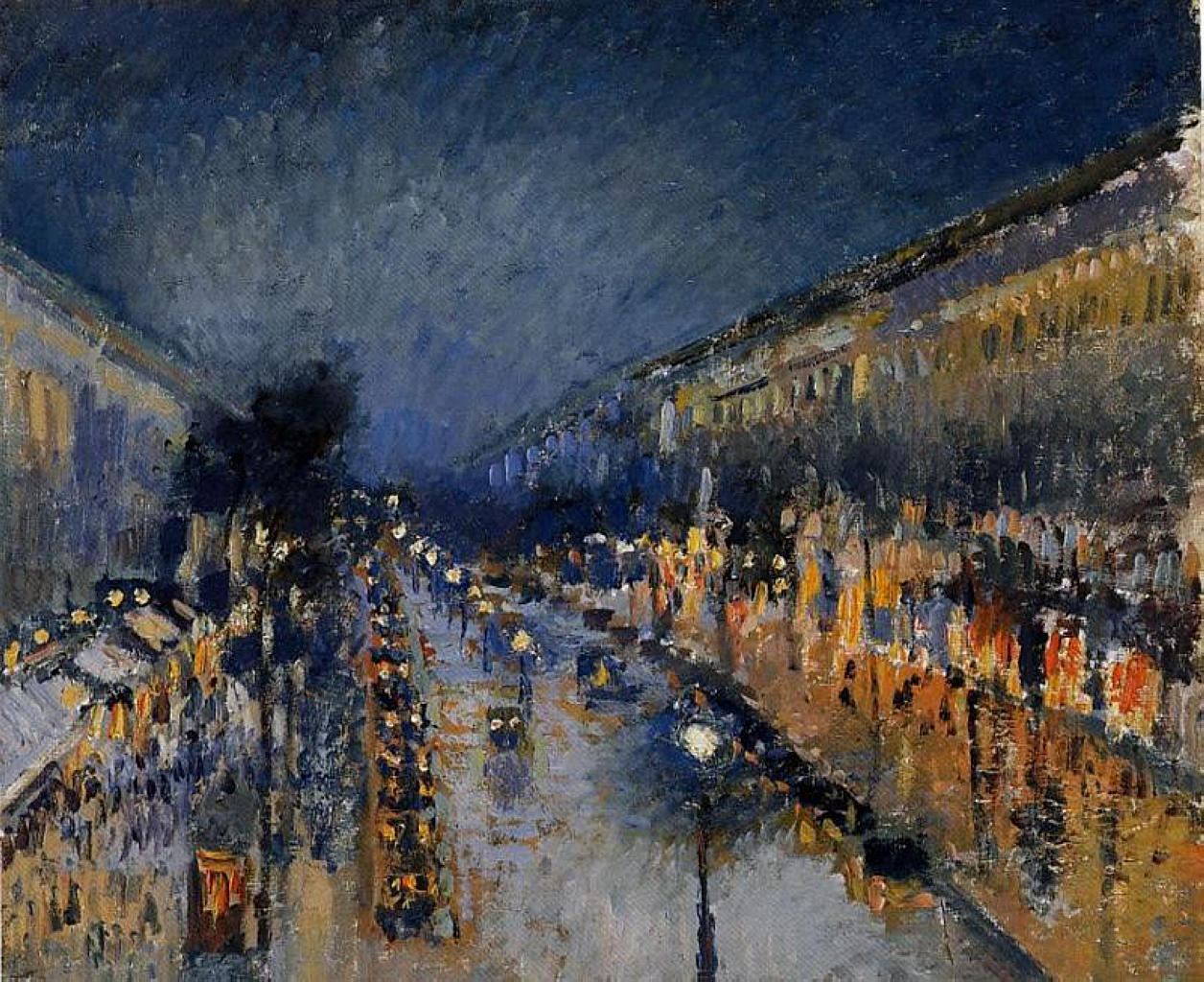
Today I went to London, and in the National Gallery saw a few works of Pissarro, one of my favourite painters. I wondered among my obvious admiration whether or not his en plein air pieces, painted with impasto so as to literally represent the movement of the scene, were not being done a disservice here being incarcerated on the wall in huge gold frames. A natural resource hauled out of the Earth and smelted into a cell for this painting otherwise in constant motion, I realised that, despite my objection to such a gaudy frame on such a delicate painting, they might be suffering the same fate.
It was around about the fields that exit Diss and become the entrance of Somewhere that I realised what was happening in my headphones. "Uoon II" is a sparse piece to be sure, but its constant drone of the same chord is also its plane; its everything. The Norfolk eye quickly learns to discern basically anything outside the norm—for a lot of people where I live this unfortunately reduces to skin colour, queerness, religion. For me it is whatever is in the process of being subsumed into the plane. The grazing sheep are taking whatever they can get from the Norfolk grass before it flattens them down, that running rabbit is evading the folding in of the landscape. Of course they will be placed anew once the process is finished and restarts but to keep one's original position on the plane, to strive as Spinoza would have it, is a near impossible task. Seeing the green of Somewhere as I have a million times before becomes more singular when I see these pockmarks of movement. Me and my partner have learned to call out to each other: "look! a Sparrowhawk! A Curlew! A Lapwing!" such that we join in with their chorus. These flecks of colour and song are the piano stabs that enter "Uoon II" at undetermined times and locations. I can hear her voice in that piano and it is beautiful to me.
I very much dislike Banksy but sometimes I wonder whether him hiding a shredder in the frame of that painting might not have been a publicity stunt but an ingenious way of forcing some movement into that cell. Suddenly it was in motion not just as itself but as a lingua franca in the global headlines it made and born anew in the five strips of paper it became out of one. If I strip the words of the once boring phrase "Today I went to London" it eventually becomes the relatively meaningful "Today I went to". This indeterminacy could be the return of the dream, or just the acknowledgement that one must not always be going somewhere, or that Somewhere must not always be predetermined. "Today I went" reverses that movement, puts me in the past tense as definitely having gone. I have attempted to do so four times. "Today I" ends with the fact I can still write a sentence that ends in a subjective declaration.
Today I am still alive.