June 7th, 2025
Jutta Hipp: Hypocritical Observations
I
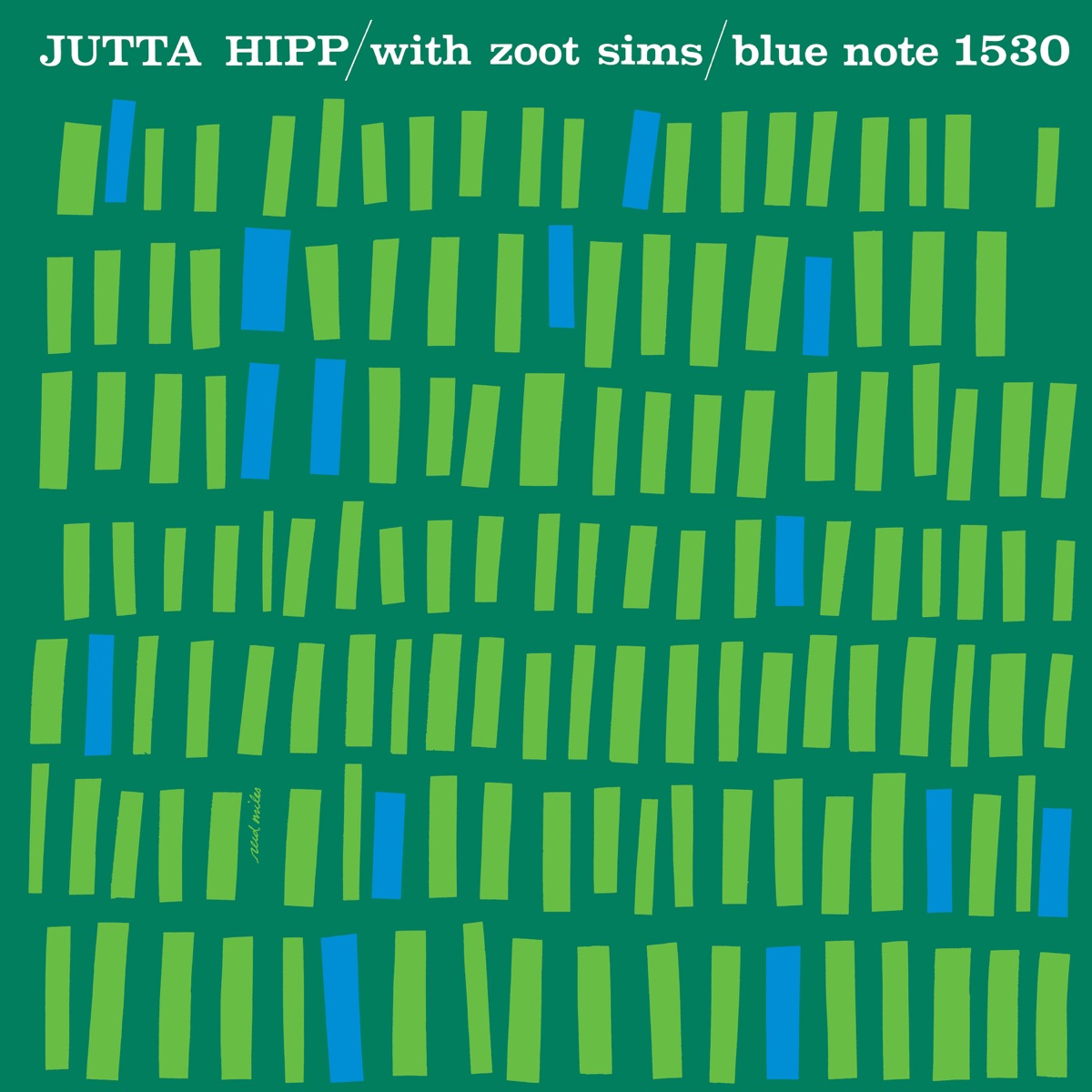
Her only studio 12" to be released while she was still active, this record sees Jutta Hipp following her biggest inspiration, Horace Silver, out of mid-50s bebop and into something a bit more relaxed. Zoot Sims is a natural accompaniment, as one of the earliest reedsmen to unreservedly adopt the cool style. Their chemistry, despite having never encountered one-another before or after, is almost miraculous—the rest of the lineup is just as curious: Ahmed Abdul-Malik's sophomore session (before, of course, venturing into Arabic jazz for most of his career hence); Jerry Lloyd on trumpet would be a complete unknown if not for some arranging work for TLC 40 years later; Ed Thigpen would eventually cross lines with Jutta by heading to Europe. The music is constantly tasteful, engineered to perfection by Van Gelder and a general delight to listen to...
II
Unremarkable, right? Well, sort of, except one so infrequently uses she/her pronouns in a jazz review. Indeed, Jutta leaves a complicated legacy behind: a double-bind, where calling attention to her identity as a woman fetishistically lionises her but ignoring it does her a disservice. Toshiko Akiyoshi, of course, remarked that she was never really sure in her early days if people were going to see her because they wanted to hear some jazz or because seeing a Japanese woman at the piano in a club was "something very new... I was strange". The personal pronoun here is crucial, I think, because the personal is at the centre of jazz at all times in a dialectic with the community it structures and is structured by.
III
However, the community jazz has been structured by is historically not one Jutta nor Toshiko belong to. There are perhaps two ways to go about this; Fumi Okiji, via W.E.B. du Bois, argues that the syncopation at the core of jazz composition is a manifestation of the double consciousness of African-American life, "the specific conditions of black modern being as a suspension of the resolution between contradictory but twinned positions... human enough for governance but too black for admittance". Gary Giddins takes a sort of Obamaite approach whereby the community jazz produces is a liberal democracy inherently blind to race. Where Okiji's incite is wildly brilliant, I find Giddins' approach dryly apolitical and that it is in a monograph simply titled Jazz—so as to be performatively authoritative—is a tellingly neoliberal erasure of the real, live exchanges of sociopolitics that happens at the level of the individual note in jazz.
IV
The problem, then, is deciding whose notes are exchangeable as narritives of a biopolitics and whose are not. I say biopolitics because jazz is as much a music of consciousness as it is of body—racialised body no less—so when Horace Silver invites his audience to uninhibit themselves as much as possible during "Filthy McNasty", is it the same as the clicks and taps we can hear throughout Jutta's set at the Hickory House? Maybe not, and hearing her in a studio setting on this record does reveal a certain difference in that regard.
V
However, while it is true that jazz is a form of storytelling unique to the African-American community, we should not beat around the bush as regards to how people typically of my skin colour envisage black storytelling: misery porn. When I was studying Terrance Hayes in the first year of my degree, my tutor expressed a frustration at the lack of stories of black joy that make their way into courses like mine, and she pointed to many of Hayes' poems that she loves because even in all of their frustration (Sonnets for My Past and Future Assassin is primarily about Trump) they radiate a resilience and pride that is not conditioned by their political conjuncture. We should not, then, reduce jazz in its most furious or lethargic moments to an inherent racialised sorrow. In its own terminology, it is call and response, not just call.
VI
Nor should we allay ourselves of its politics as to reduce to mere aesthetic signifiers. The common argument is to say jazz is then a manifestation of freedom, but freedom from what, exactly? Of course: exploitation—the very form of jazz qua blues is most likely an augmentation of a rhythmic pattern originating in the folksongs of West Africa where a majority of slaves were taken from. This information was provided to me by Giddins, who proceeds to ignore it as vital context for the rest of his 800-page book and instead basically declares jazz a triumph of homogenous nationalism, Freedom in all its capital letters. And, sure, jazz can certainly be a celebration of that, but are we not still tied as white people—me and Giddins both—to an inherent connection between black storytelling and misery? Okiji instead dialecticises this by postulating jazz as a form of play "within the subject in-itself": not decentred from its origin point but not inherently twinned with it. She takes an awfully un-romantic view of jazz—most amusingly weaponizing it against Adorno's explication of Mahler—but this means we can still keep alive the biopolitics of jazz as a form while also retaining, and not in contradistinction, the individuality of the jazz piece which has a meaning necessarily distinct from whatever our presumptions of jazz may reify it into.
VII
You may at this point sense I am headed in a catastrophic direction. Jutta suffered the effects of Nazi prosecution, post-war famine and remains tokenised by her gender; jazz as a form is produced by the social inequalities faced by African-Americans... take it away John Lennon. No, I am certainly not going to argue that, but it does mean Jutta is able to divulge a different kind of storytelling if we take Okiji's theory at face value. This music stays rooted firmly in tradition—the first song is called "Just Blues", after all—but it is too a white woman playing in-herself. Is her ability to play away from the very much not-white social context of jazz proof that Giddins' liberalisation of the music is correct? Not exactly, but it does mean that she is able to use, formalistically, a mode of storytelling that represents individual liberation because she found herself in a post-war community built upon a rejection of the colourist segregation it was produced by. It is identity politics bereft of differential identity; figures like Benny Goodman, Norman Granz and, presented here, Zoot Sims attest to this. No, people tapped their feet to Jutta at the Hickory House because she was playing jazz god damn it: Horace Silver's calls for uninhibition are, as I read it, a mostly performative exchange between a musician and an audience who know that they are always-already unhibited because that is precisely how the music is structured.
VIII
The difficulty in this is that Jutta was fetishised as a woman. Even in language: we have "jazz musician" as the non-identity phrase, "jazzman" as an adjective of identity... "jazzwoman"? It is literally absent from the dictionary. Leonard Feather called her a "funny little thing", a phrase so obviously feminised that it does weigh on my mind whether her storytelling contained some kind of response to her persistent ogling from a heavily masculinised industry—not in the Lennon way, but in the way that Akiyoshi decided to solve the same problem: doubling down. In Akiyoshi's jazz can be found shōmyō, gagaku and harmonic theory completely distinct from Western musical tradition. Reviews of Jutta's jazz frequently opine that there is just some un-nameable thing in her music that sounds feminine. Could be misogynistic essentialism that would instantly fail a blind test; could hold water. Ever elusive and shy, she was apparently uncomfortable with fame, dropped out of the scene and was found a few decades later working as a seamster. A drop in the ocean by anyone else's metric, but she was a woman, playing jazz!
IX
So in both a sociopolitical and musical sense I find Jutta Hipp a bit of an unsolvable mystery, and this is one of the only artifacts of her we have left behind. It is simply fantastic jazz, there is no doubt about that. Her playing is precise but with many an accidental that swiftly recall the bebop era, her right hand is stiff, blocky and angular but her comping always fluid. Sims has a sharp tone not necessarily suited to standards and balladeering but in a record already full of contradiction, one more only adds to the intrigue: his soloing is magnificently tasteful.
X
A possible solution, however, may lie in the drums of Ed Thigpen. As usual, he is excellent, but it is such a curiosity that Jutta fled Germany for America in the 1940s and Thigpen fled America for Denmark thirty years later, citing an exhaustion with ongoing racism in American society. For him, I suppose, living inside the dialectic wore off and he decided an outside view would be better—he was among many, including Horace Parlan whose blocky, angular style would pair with Thigpen for many records on Steeplechase. It would seem that this unsolvable style was more common than just in Jutta, but it is endlessly fascinating to me that two very distinct identities would coalesce for this recording session, notate their frustrations- and their freedoms-in-common, before heading back off in their own directions.
Works consulted:
Fumi Okiji, Jazz as Critique
W.E.B. du Bois, Darkwater
Gary Giddins, Jazz
LA Times on Akiyoshi
Jutta Hipp, At the Hickory House, Vol. 1, liner notes