September 1st, 2025
Review: Frente Cumbiero - Inconcreto & Asociados
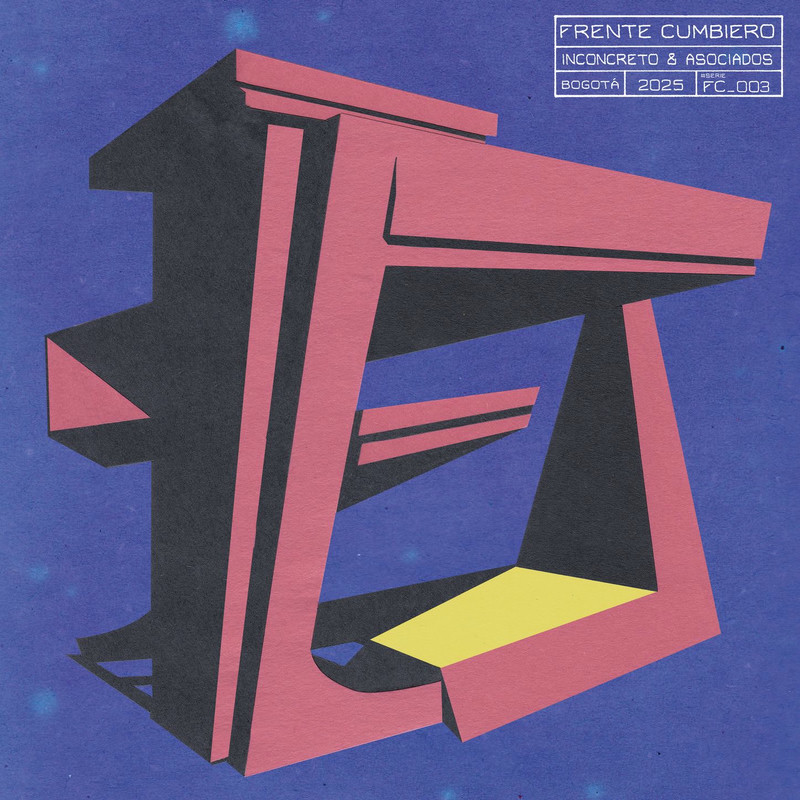
When Sidney Bechet came over with Will Cook, protégé of Dvořák, to the United Kingdom in 1919 to perform with an orchestra to King George V, it represented essentially the first line of flight for jazz between the USA and the UK. His instrument, the clarinet, immediately cuts through to the centre of most Dixieland recordings, a form largely without soloists in the way we know them now. He was by and large the first famous jazz soloist insofar as his melodies dictated the dynamics of the band rather than the repetition of that sort of homogeneous bounce that characterises much of Dixieland. To a degree, however, I think he was always becoming-soloist in the sense that the clarinet exudes a timbre far different to most other instruments that get used outside of the symphony orchestra. There is a cutting-through of the clarinet; to declare Bechet the by and large first jazz soloist is to move his playing into the problematic of a solo in the contemporary form descended from the bop era, where within his own recordings his presence can easily be felt as difference regardless of the dynamics of the band around him.
Colombian cumbia, in contrast to jazz which has a quite firm grip on its lineage and the British repertoire—insofar as woodwinds have a special relationship with new pastoralism starting with Arnold Bax's quintet, a piece that set him on the road to holding the nationalistic Master of the King's Music position—has a relative controversy about its origin point. Whether ethnologically from Carribbean Colombians, variegated indigenous traditions, Afro-Colombians or geographically from a point as singular as Cartagena or heterogeneous as Africa itself, the conclusions drawn on writing about cumbia's history are usually argumentative. The origin of writing about the origin of cumbia seems to be undefined; it appears as one always-already existing dialogue. In a sense this reflects the folkloric nature of the music itself: it is mythologically evocative rather than real-historically (jazz) or intra-ideologically (British romanticism). Folklore is a kind of supra-ideological thing, performed not exclusively within an already structured object but acting also as the (re-)structuring force.
A solo in modern jazz is the performance of the discourse of the music, where a group problem is worked on individually-sequentially; I would suggest that the "solos" in Inconcreto & Asociados are the working out of the process of the discourse in the first place. As such, the rest of the band do not heed this process because they are all of them in the same—we are not even in the problematic of the solo on this record, where the drummer may ease up to make room for the piano after playing for the saxophone. This is not to say that jazz is bereft of some kind of aesthetic quality, rather that it perceives its object far clearer than cumbia. When Althusser says that the origin point "thinks that which has not to be thought" it does not mean jazz is thoughtless music, rather that it acts within a problematic already structured by a thought-object: the blues. Jazz is a mediation of the origin point as a concept, arguably then pushed to its limits with the free jazz movement. Cumbia, insofar as its origin point cannot be delimited exclusively, represents this difference in itself through the traversal of concepts: dance-forms, folk melodies and the representation of the reproduction of Colombian folklore through the birth of new generations of dancers and musicians.
Frente Cumbiero, then, occupy a special space because they comprise musicians that have contributed greatly to a kind of experimental revivification of cumbia, bringing it into direct contact with Carribbean music and giving it a real-historical object (see Cumbia Siglo XXI). That object is cumbia itself, given that what is formed in the imaginary is transposed into the real. Colombian mythology is/was the imaginary representation of the real structures of its society, transposed into the real as the structuring force of a supraideological folklore, whose society in turn retains the imaginary component of this folklore which is spontaneously actualised in musical form, regardless of a specific origin in point, as the dances of cumbia. That concept, itself now comprised of components real and ideological, can be taken up as an object. If Eblis Alvarez traces the historical lines of this concept, then Mario Galeano traces its present.
This present is, of course, made up of contractions of past becoming-present. What is contained within this record then is all of the dialogues of origin point as different lenses through which cumbia can be mediated: not located in exclusively, but actualised by. Vallenato, porro and guaracha all appear, but also jazz, asymptotically. Its main vehicle is the clarinet, that apparatus of cutting-through that alerts the listener to the differential discourse of the album at all times. In one timbre is found the raw expression of the record, yet it does not exist as solo because it becomes the difference of the other instruments just as much as they become its. In that magical motif of "Paratebueno", floating around the edges of the mix and rhythmically folded in and out by the hi-hat, a kind of univocity is being played, the clarinet its signal. Galeano has said that the project of the band is essentially an internationalisation of cumbia insofar as cumbia already contains international influences, and this has taken them to the USA, Kenya, Japan, and much to my own personal happiness, the UK. Inconcreto & Asociados finds in its origin point only its own expression, and in this realisation explodes in a mass of directions at once, routing right into the heart of cumbia, an organ that has always-already been pumping blood through valves which need not have a definite origin so long as they all lead back to that impossibly-harmonically-rhythmically rich centre.