September 15th, 2025
Review: Kara-Lis Coverdale - A Sphere of Actions in a Series of Forever
Here is the beginning of a piece that I have been composing lately:
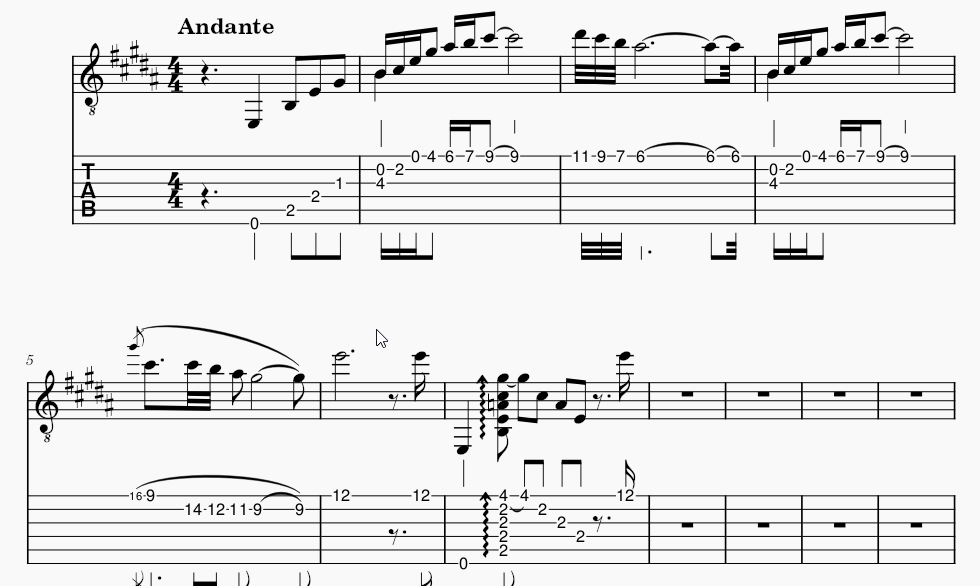
These aren't really my phrases; they are Déodat de Sévérac's from his Cerdaña. Granted, I transcribed the piano notation to guitar and then up a semitone for tuning purposes but I am essentially working with content that isn't my own by origin. However, I think in one sense or another, Sévérac wasn't either; Cerdaña is devoted to the natural scenery of Catalonia and we could say that it finds that as its first cause. My piece finds Cerdaña as its first cause, and by nature Catalonia second.
Unlike Sévérac, though, I have zero experience with Catalonia nor is my piece dedicated to it. Our commonality is then the first cause not of the space of Catalonia but of space in general. Piano music has the brilliant ability to essentially produce space in and for itself, the longer you hold down the pedal the longer each resonance detaches itself from your notation and starts to become the actualised, natural environment of the piece. Frederic Mompou was a famously socially anxious composer; whereas we could say Sévérac's music produces a public space—literally the commons, grass, water, bark, wheat—Mompou produces a private one—the soirée, the dinner party; in my worst moments purely the bedroom itself. Van Gogh, of course understood the latter to its most tragic extent.
Classical guitar does not come with a pedal. When Coverdale plays her piece "Lowlands" on prepared piano, the space of the recording is not always produced by detached resonance but by the way the hammers strike the strings. In a prepared piano the strings are not being struck as intended by the manufacture of the piano itself; the space is being produced in an unorthodox fashion and the composer is conscious of that. When Reginald Smith Brindle wants to do this, he has to strike his guitar with his fist or palms, as I do. If I want to hold on to the space of my transposition of Cerdaña I have to create the overtones and the vibrato with my fingertips and strain myself in the process. The piano exists, then, it its own space delimited in a completely different fashion, or rather, delimited only insofar as the objects you can place near the hammers. Coverdale's playing remains, more or less, the same in nature. There is no harming of the instrument or of the composer but the space remains just as malleable.
I think this is why I appreciate piano music so much. Prokofiev's third piano concerto is in C major but when he strains for those non-diatonic flourishes you can feel the space around you bending. In open-backed headphones, I am conscious of the chromaticism escaping even when I am only hearing the internal effects. My room becomes parley to an external dialogue I can only hear from the inside. When the hammer strikes Coverdale's piano on "Lowlands", or feathers the strings on "Circularism", it is the striking that creates the space insofar as people like to say 'aha! the piano is actually a percussion instrument'. I often believe they are saying this as an aphoristic fun fact but without knowing how profound they are actually being: the piano literally strikes space into existence, the hammer is the vehicle of its duration in a literal and a Spinozian sense. It is breathed in and then out and then gone: a series of actions in a sphere of forever. "Lowlands" plays to the melody of a respiratory repetition—sometimes I am self-conscious that reproducing this on a simple guitar is too difficult for anyone to bother, and yet I am always caught up in the obsession of trying. When I am playing my lines of Sévérac, I wonder what it is that my room hears.